
Book a consultation: Book a consultation with Spring Grove Counseling
Understanding Mental Health in Hispanic Families
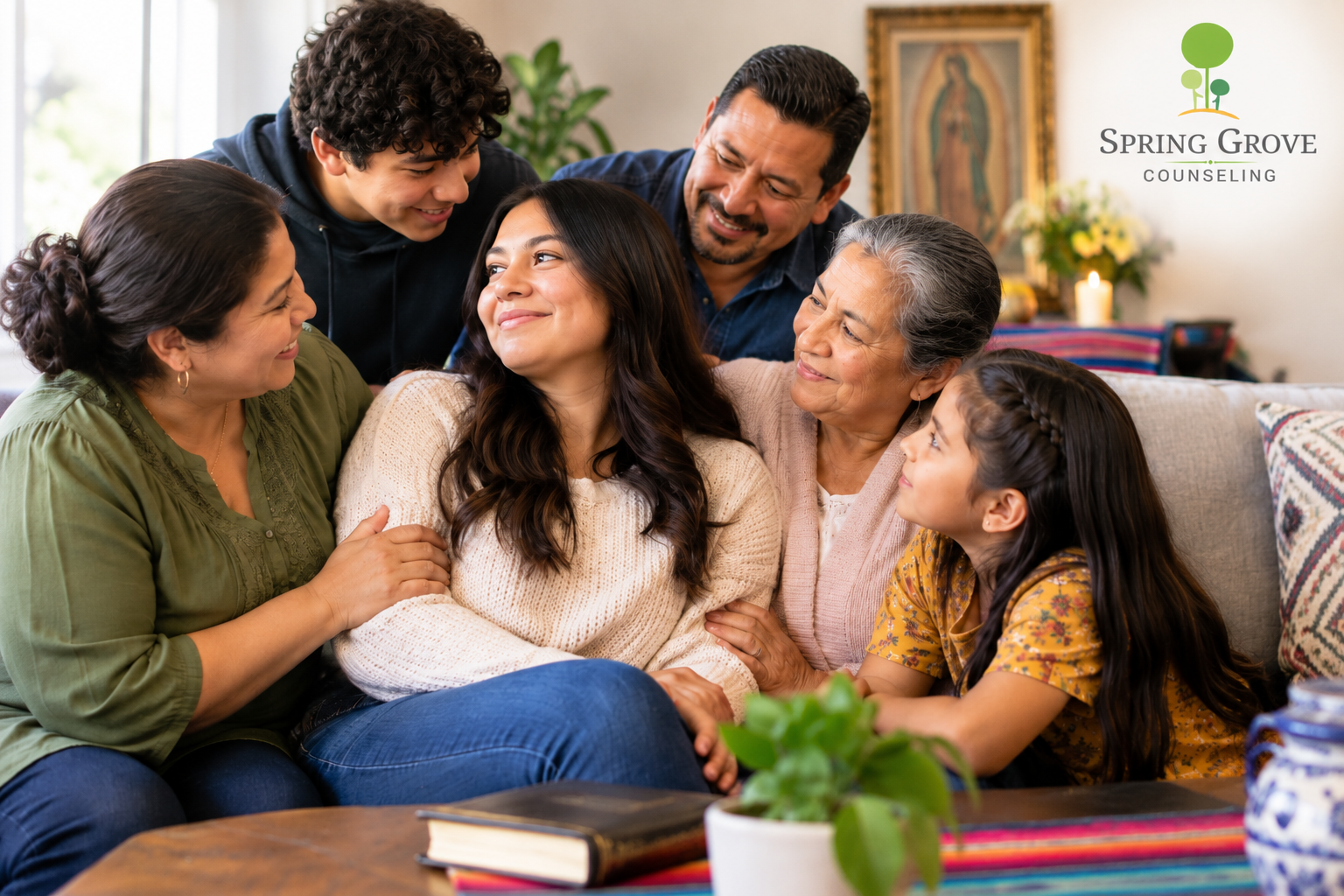
As a therapist, I have learned that talking about mental health in Hispanic families is not always easy, especially when family, culture, faith, and tradition are deeply connected to how we understand ourselves. Within many Hispanic families, family is everything. We celebrate together, support one another during difficult times, and often make sacrifices for the people we love. There is so much beauty and strength in that connection.

But sometimes, that same closeness can make it difficult to say, “I’m struggling.”
Many of us grew up hearing phrases like “échale ganas,” “no pienses en eso,” “tienes que ser fuerte,” or even “otros están pasando por cosas peores.” Usually, these words are not meant to hurt us. They often come from people who love us and who learned to survive difficult circumstances by simply continuing to move forward.
Our parents and grandparents may have experienced poverty, immigration, discrimination, family separation, loss, or other painful situations without ever having the opportunity to process what happened to them. Therapy may not have been available, affordable, culturally accepted, or even something they knew existed.
For many of them, survival was the priority.
Because of that, emotional struggles were sometimes handled privately. You prayed. You worked harder. You stayed busy. You took care of your family. You kept going.
And there is strength in that resilience.
But I also believe there is strength in saying, “I need help.”
When We Don’t Have the Words to Describe Our Mental Health
One thing I often see in counseling is that people are experiencing very real emotions but do not always have the words to describe them.
Someone may be experiencing anxiety but describe themselves as simply being nervous or stressed. Someone struggling with depression may believe they are being lazy or ungrateful. A person carrying childhood trauma may have spent years believing, “That happened a long time ago. I should be over it by now.”
Sometimes family members do not understand either.
They may respond with, “But you have a good life. What do you have to be depressed about?”
Although comments like these can be painful, they do not always come from a lack of love. Sometimes they come from a lack of understanding about mental health.
This is why I believe conversations about mental health are so important. When we learn to recognize and name our emotions, we can begin understanding what we need instead of judging ourselves for what we feel.
We Can Love Our Families and Still Acknowledge the Hurt
Therapy can bring up complicated feelings about family.
One of the fears people sometimes have about counseling is that a therapist is going to blame their parents for everything that has gone wrong in their lives. That is not how I view therapy.
I believe two things can be true at the same time.
Our parents may have done the best they could with what they knew, and some of their choices may still have hurt us.
We can appreciate the sacrifices our families made while also recognizing patterns that we do not want to continue.
Maybe emotions were not discussed in your home. Maybe conflict involved yelling, shutting down, or pretending nothing happened. Perhaps boundaries were viewed as disrespectful. Maybe love was expressed through food, sacrifice, hard work, and providing rather than through affection or words.
Understanding those patterns is not about disrespecting our families.
It is about understanding ourselves.
Therapy allows us to ask: What do I want to keep from my upbringing, and what would I like to do differently?
That question can be incredibly powerful.
If you are ready to explore your own experiences in a supportive environment, book a consultation with Spring Grove Counseling to learn more about counseling options.
Healing Can Begin With One Person
One of my favorite things about the work I do is watching someone realize that they have the ability to change a pattern that may have existed in their family for generations.
Healing does not always look dramatic.
Sometimes it is a mother telling her child, “It’s okay to be sad. Tell me what happened.”
Sometimes it is an adult child learning that setting a boundary does not mean they do not love their parents.
Sometimes it is a husband learning how to talk about fear instead of expressing it through anger.
Sometimes it is a woman realizing that taking care of herself does not make her selfish.
And sometimes healing is simply allowing yourself to feel emotions that you have spent years pushing aside.
Small changes can have a lasting impact on families.
When we learn healthier ways to communicate, manage difficult emotions, and respond to conflict, those skills can influence our relationships with our children, partners, parents, and other loved ones. We do not have to change everything at once. Even one intentional step can begin creating a different experience for the next generation.

Faith and Therapy Do Not Have to Compete
For many Hispanic families, faith is also an important part of life. Prayer, church, Scripture, and a relationship with God can provide tremendous comfort during difficult seasons.
I believe there can be room for both faith and mental health care.
You can pray and go to counseling.
You can trust God and experience anxiety.
You can have a strong faith and struggle with depression.
Seeking professional support does not mean that your faith is weak. Sometimes faith is one of the greatest sources of strength a person brings into the counseling room.
When faith is important to a client, I believe it deserves to be respected as part of their story and, when they desire it, incorporated into the healing process.
Therapy does not have to replace the sources of strength you already have. It can be another way to care for yourself while honoring the values that matter most to you.
Changing the Conversation for the Next Generation
When we begin taking care of our mental health, we are often doing something much bigger than helping ourselves.
We may also be changing what emotional health looks like for our children and grandchildren.
Imagine children growing up knowing they can say, “I’m overwhelmed,” “I’m scared,” “I need help,” or “I need some space,” without feeling ashamed.
Imagine families where apologizing is not viewed as weakness, boundaries are not automatically interpreted as rejection, and asking for counseling is treated with the same compassion as seeking help for a physical illness.
That kind of change can start with one person.
There is so much strength within Hispanic families—our love for family, our resilience, our faith, our traditions, our humor, and our ability to come together when someone needs us.
Taking care of our mental health does not mean giving up those values.
It means making room for another one: emotional well-being.
As a therapist, I want people to know that they do not have to choose between honoring where they came from and becoming emotionally healthier. We can appreciate our families, understand their stories, and still choose to heal parts of our own.
Sometimes the first step is simply permitting ourselves to say:
“What I’m feeling matters, too.”
Frequently Asked Questions About Mental Health in Hispanic Families
1. Why can it be difficult to talk about mental health in Hispanic families?
Family expectations, cultural traditions, stigma, and beliefs about strength and privacy can sometimes make emotional struggles difficult to discuss. Every family is different, but some people may have learned to handle problems privately rather than seek outside support.
2. Does going to therapy mean I am blaming my parents or family?
No. Therapy can help you understand your family history, recognize both the strengths and challenges of your upbringing, and decide which patterns you want to continue. You can love and appreciate your family while acknowledging experiences that have hurt you.
3. Can I incorporate my faith into therapy?
Yes, when it is important to you and appropriate for your treatment goals. You can discuss your faith with your therapist and explore how spiritual beliefs and practices may support your emotional well-being.
4. How can therapy help me build healthier family relationships?
Therapy can help you recognize emotional patterns, communicate more effectively, establish healthy boundaries, manage anxiety and other difficult emotions, and develop new ways of responding to conflict. These skills can support healthier relationships over time.
Take the Next Step Toward Emotional Well-Being
You do not have to navigate anxiety, family challenges, or difficult emotions alone. Seeking support is not a rejection of your culture, your family, or your faith. It is an opportunity to understand yourself more deeply and build a healthier future.
Looking for help with individual counseling? Spring Grove Counseling has offices in Cypress, TX, and Spring, TX. We also offer online therapy in New Mexico, Utah, California, and Idaho. Our therapists are trained in individual counseling and ready to help. Book a consultation to get started.
About the Author
Read more about Claudia Zarate and her work at Spring Grove Counseling.
Additional Resources
Explore more from Spring Grove Counseling:
If You Need Immediate Support
If you or someone you know is experiencing a mental health crisis, call or text 988 in the United States to reach the Suicide & Crisis Lifeline. Support is available 24 hours a day, 7 days a week. If there is immediate danger or a life-threatening emergency, call 911.
Leave a Reply